Google Gemma 4: How a 31-Billion-Parameter Open Model Is Rewriting the Rules of AI Accessibility
On April 2, 2026, Google DeepMind released Gemma 4 — a family of open AI models that is challenging fundamental assumptions about what open-weight models can achieve. With its flagship 31B Dense variant currently ranked as the #3 open model in the world on the Arena AI text leaderboard, Gemma 4 represents a watershed moment in the democratization of artificial intelligence. For the first time, a model small enough to run on consumer hardware is delivering performance that rivals proprietary systems costing orders of magnitude more to operate.
Why Gemma 4 Matters: The Intelligence-Per-Parameter Revolution
The AI industry has long operated under a simple assumption: bigger models produce better results. GPT-4, Claude, and Gemini Ultra all rely on hundreds of billions (or even trillions) of parameters to achieve their remarkable capabilities. Gemma 4 upends this paradigm. Google DeepMind describes it as delivering "an unprecedented level of intelligence-per-parameter," and the benchmarks back up that claim.
The Gemma 4 31B Dense model scores 89.2% on the AIME 2026 mathematics benchmark, 84.3% on GPQA Diamond (graduate-level science reasoning), and an impressive 80.0% on LiveCodeBench v6 for competitive coding — a massive leap from the 29.1% achieved by its predecessor, Gemma 3 27B. On agentic tool use benchmarks (τ2-bench), it scores 86.4%, demonstrating that this is not merely a language model but a foundation for autonomous AI agents capable of interacting with real-world tools and APIs.
What makes these numbers extraordinary is the model's size. At 31 billion parameters, Gemma 4 is a fraction of the size of leading proprietary models, yet it competes with — and in some cases outperforms — models that are 10 to 13 times larger. This efficiency breakthrough has profound implications for who can build with state-of-the-art AI and where those models can run.
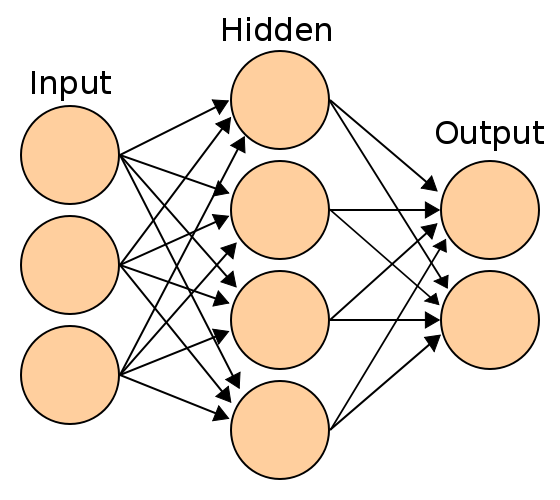
An illustration of a generic artificial neural network topology. Image by Cburnett via Wikimedia Commons, licensed under CC BY-SA 3.0.
A Four-Model Family: From Edge Devices to Data Centers
Gemma 4 is not a single model but a carefully designed family of four variants, each targeting a different deployment scenario:
Effective 2B (E2B) — The smallest variant, optimized for smartphones, IoT devices, and Raspberry Pi-class hardware. Despite its tiny footprint, E2B supports native audio input for speech recognition alongside text and image processing. It operates within a 128K token context window.
Effective 4B (E4B) — A step up in capability while remaining edge-friendly. Like E2B, it features native audio processing and a 128K context window, making it ideal for on-device personal AI assistants that need to understand voice, text, and visual inputs simultaneously.
26B Mixture of Experts (MoE) — This model activates only 3.8 billion parameters per forward pass while drawing on 26B total parameters. It holds the #6 spot on the Arena AI leaderboard and scores 88.3% on AIME 2026 — remarkably close to its larger sibling while requiring dramatically less compute per inference. The MoE architecture makes it particularly attractive for cost-sensitive cloud deployments.
31B Dense — The flagship model, designed for maximum intelligence. With a 256K token context window and top-tier benchmark scores across mathematics, coding, science, and agentic tasks, this variant targets developers building the most demanding AI applications.
Multimodal by Design: Beyond Text-Only Intelligence
Every model in the Gemma 4 family natively processes images and video, supporting variable resolutions and excelling at visual tasks like optical character recognition (OCR), chart understanding, and visual question answering. The edge-optimized E2B and E4B variants go further, adding native audio input for speech recognition and understanding — a first for open models at this scale.
This multimodal capability is not an afterthought bolted onto a text model. Gemma 4 was designed from the ground up to reason across modalities, enabling applications that combine visual perception with language understanding. A developer building a manufacturing quality-control system, for example, could deploy the E4B model directly on inspection hardware, processing camera feeds and voice commands locally without any cloud dependency — and at no per-inference cost.
Apache 2.0: The Licensing Choice That Changes Everything
Perhaps the most consequential decision Google made with Gemma 4 is releasing it under the Apache 2.0 license — one of the most permissive open-source licenses available. Unlike Meta's Llama models, which carry custom licenses with usage restrictions for large commercial deployments, Apache 2.0 imposes virtually no limitations. Companies of any size can use, modify, and distribute Gemma 4 commercially without licensing fees or usage caps.
This licensing choice positions Gemma 4 as the default foundation model for startups, enterprises, and researchers who want maximum flexibility. Combined with its strong benchmark performance, the Apache 2.0 license could accelerate adoption in industries — healthcare, finance, legal, government — where licensing clarity and the ability to run models on-premises are non-negotiable requirements.
The Bigger Picture: Open Models in the Age of Agentic AI
Gemma 4 arrives at a pivotal moment in the AI industry. The Anthropic-originated Model Context Protocol (MCP), which recently crossed 97 million monthly SDK downloads, has become the standard mechanism by which AI agents connect to external tools, APIs, and data sources. Every major AI provider now supports MCP, and the protocol has been donated to the Linux Foundation's Agentic AI Foundation (AAIF).
Gemma 4's strong agentic benchmark scores — particularly its 86.4% on τ2-bench — suggest that Google is positioning these open models as first-class citizens in the emerging agentic ecosystem. Developers can now build autonomous agents that plan, reason, and act using tools, all powered by an open model running on their own infrastructure. This is a significant shift from a world where agentic capabilities were the exclusive domain of proprietary API services.
The competitive landscape is also intensifying. Meta recently launched Muse Spark under Alexandr Wang's leadership at Meta Superintelligence Labs, marking a strategic pivot away from its open-source Llama lineage toward proprietary models. Meanwhile, OpenAI has crossed $25 billion in annualized revenue and is preparing for an IPO potentially valued at $1 trillion. Against this backdrop of consolidation and commercialization, Google's decision to release its most capable open models under Apache 2.0 stands out as a deliberate counter-strategy — one that bets on ecosystem growth over direct monetization.
What Developers Should Know
Gemma 4 models are available now through Google AI Studio, Hugging Face, Kaggle, and Google Cloud's Vertex AI. The models support over 140 languages and are optimized for deployment across a wide range of hardware, from NVIDIA GPUs and Google TPUs to Apple Silicon and Qualcomm mobile processors. Key integration points include compatibility with popular frameworks like PyTorch, JAX, and TensorFlow, as well as optimized inference through tools like vLLM and llama.cpp.
For developers already building with Gemma 3, the migration path is straightforward — Gemma 4 maintains architectural compatibility while dramatically improving performance across every benchmark category. The extended context windows (128K for edge models, 256K for the larger variants) also open new possibilities for applications that need to process long documents, extended conversations, or complex multi-step reasoning chains.
Conclusion: The Future Runs Locally
Gemma 4 is more than a model release — it is a statement about where AI is heading. The era in which cutting-edge intelligence required billion-dollar infrastructure and proprietary API access is drawing to a close. With Gemma 4, a single developer with a modern laptop can run a model that ranks among the world's best, completely offline, at zero marginal cost, with full commercial rights.
Whether this marks the beginning of a true democratization of AI or simply a new front in the platform wars between Google, Meta, OpenAI, and Anthropic remains to be seen. But for the millions of developers, researchers, and businesses worldwide who have been priced out of the frontier AI race, Gemma 4 is an unambiguous signal: the future of AI is open, it is efficient, and it runs on your hardware.
한글 요약
2026년 4월 2일, 구글 딥마인드는 오픈 AI 모델 패밀리인 Gemma 4를 공개했습니다. 4가지 변형 모델(2B, 4B, 26B MoE, 31B Dense)로 구성된 이 모델군은 아파치 2.0 라이선스로 배포되어 상업적 활용에 사실상 제한이 없습니다. 특히 31B Dense 모델은 Arena AI 텍스트 리더보드에서 오픈 모델 세계 3위를 기록했으며, 수학·코딩·과학 추론·에이전트 도구 사용 등 전 영역에서 자신보다 10배 이상 큰 모델들과 경쟁할 수 있는 성능을 보여줍니다.
Gemma 4의 가장 혁신적인 측면은 '파라미터당 지능'의 극대화입니다. 소비자용 하드웨어에서도 구동 가능한 크기의 모델이 최정상급 성능을 달성함으로써, AI 기술의 민주화가 한 단계 더 진전되었습니다. 모든 모델이 이미지와 비디오를 기본 지원하고, 엣지 모델은 음성 입력까지 처리할 수 있어 스마트폰부터 데이터센터까지 다양한 환경에서 멀티모달 AI 애플리케이션을 구축할 수 있습니다. 메타가 독점 모델로 전환하고 OpenAI가 IPO를 준비하는 시점에, 구글의 이번 오픈소스 전략은 AI 생태계의 방향성에 중요한 시사점을 던지고 있습니다.