Google Gemma 4: The Open-Weight AI Model Family That Punches Far Above Its Size
Google DeepMind's Gemma 4 is rewriting what's possible with open-weight AI models. Released under the Apache 2.0 license, this family of four models brings frontier-level reasoning, multimodal intelligence, and agentic capabilities to everything from smartphones to workstations — and anyone can use them for free, commercially or otherwise.
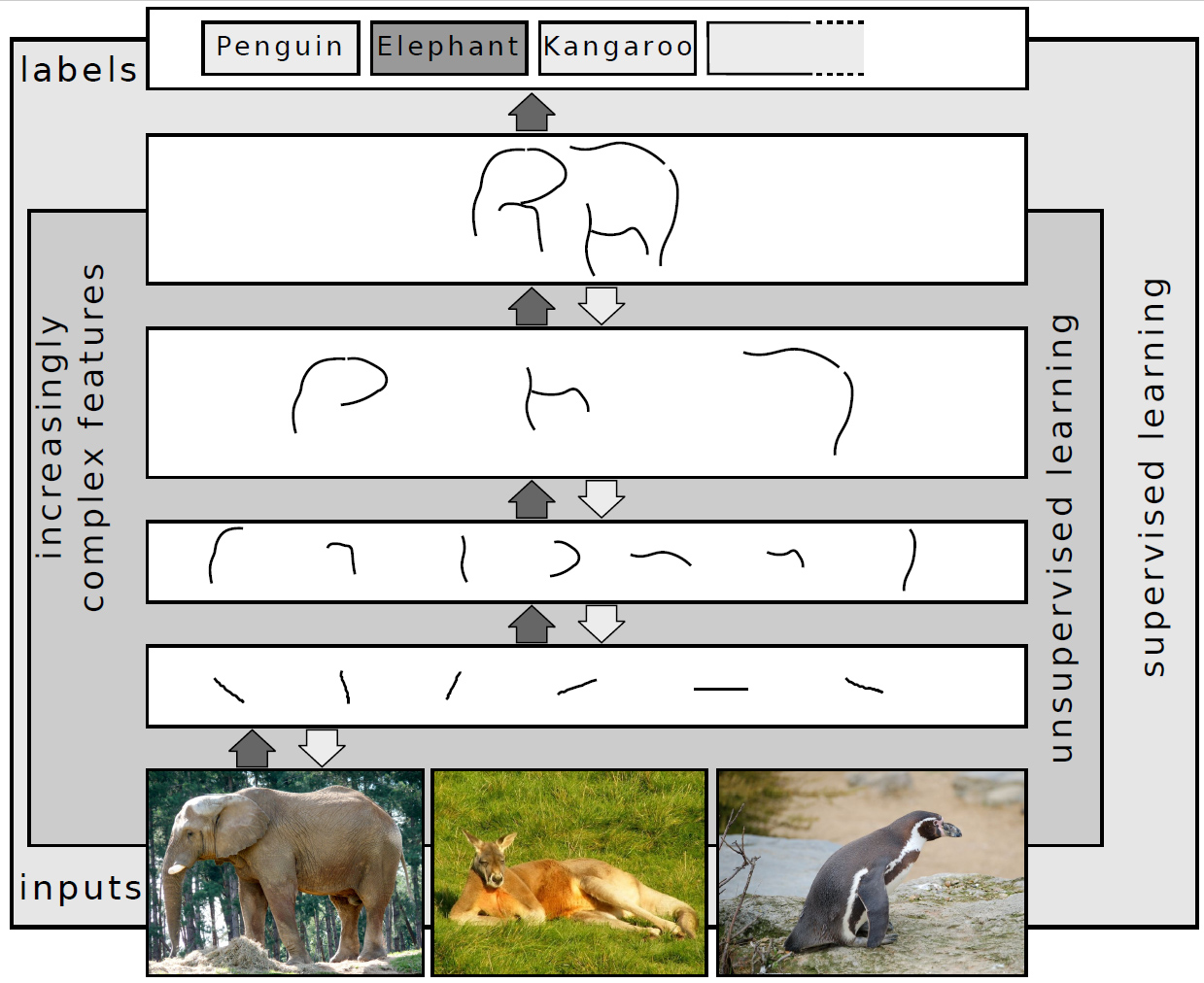
Image: Deep learning hierarchical feature learning. By Sven Behnke, Wikimedia Commons, CC BY-SA 4.0.
A New Era for Open AI Models
On April 2, 2026, Google DeepMind officially released Gemma 4 — the most capable family of open-weight AI models ever produced by the company. Built from the same world-class research and technology that powers the proprietary Gemini 3 series, Gemma 4 represents a philosophical and technical leap forward: it proves that truly powerful AI does not have to remain locked behind API paywalls.
What makes Gemma 4 exceptional is not just one headline metric, but the breadth of its capabilities. These models process text, images, video, and audio natively. They reason through complex multi-step problems with configurable thinking modes. They handle context windows of up to 256,000 tokens. And perhaps most importantly, they run completely offline on local hardware — from a Raspberry Pi to a consumer GPU to a professional workstation — with near-zero latency.
The decision to release Gemma 4 under the Apache 2.0 license is significant. Unlike more restrictive open-source AI licenses that impose usage caps or acceptable-use restrictions, Apache 2.0 offers complete commercial freedom. There are no monthly active user limits, no geographic restrictions, and no requirement to share modifications. This positions Gemma 4 as arguably the most permissively licensed frontier AI model family available today.
Four Models, Four Use Cases
Gemma 4 ships in four carefully differentiated variants, each optimized for a specific deployment scenario. The smallest, Gemma 4 E2B, packs 2 billion parameters into a footprint designed for smartphones and ultra-low-power edge devices. Despite its compact size, E2B supports native audio and video processing — capabilities previously reserved for much larger models.
Stepping up, the E4B variant (4 billion parameters) targets edge computing devices like IoT gateways and embedded systems, offering a strong balance between capability and computational efficiency. Both E2B and E4B support the full multimodal input stack: text, image, video, and audio.
The 26B Mixture-of-Experts (MoE) model is perhaps the most architecturally interesting of the four. While it contains 26 billion total parameters, only 3.8 billion are active during any single inference pass, thanks to the MoE routing mechanism. This means it can run on consumer-grade GPUs — think an NVIDIA RTX 4090 or even a well-configured laptop — while delivering performance that rivals models many times its size. For independent developers and small startups, this variant represents a genuine paradigm shift in accessible AI power.
The flagship 31B Dense model rounds out the lineup, targeting workstations and small-scale server deployments. This is the variant that posts the headline benchmark numbers, and those numbers are staggering.
Benchmark Performance That Defies Model Size
Gemma 4's benchmark results challenge the prevailing assumption that bigger models always win. The 31B Dense variant scores 85.2% on MMLU Pro, a demanding evaluation of professional-level knowledge across dozens of domains. On AIME 2026, the standard test for mathematical reasoning among AI models, it achieves an astonishing 89.2% — up from a mere 20.8% posted by its predecessor, Gemma 3. That is not incremental improvement; that is a generational leap.
Competitive programming tells a similar story. On Codeforces, the community benchmark for algorithmic problem-solving, Gemma 4's ELO rating jumped from 110 (Gemma 3) to 2,150 — placing it at the expert competitive programmer level. On the GPQA Diamond benchmark for graduate-level science reasoning, it scores 84.3%, nearly doubling Gemma 3's 42.4%. On Arena AI, a crowd-sourced human preference ranking, Gemma 4 currently sits at number three globally.
These results become even more remarkable when you consider that Gemma 4's 31B parameters are a fraction of the size of competing closed-source models from OpenAI, Anthropic, and others, some of which operate at hundreds of billions or even trillions of parameters. Google's research team has clearly achieved breakthrough efficiency in how intelligence is encoded per parameter.
Built for the Agentic Future
Perhaps the most forward-looking aspect of Gemma 4 is its native support for agentic AI workflows. All four models come with built-in capabilities for function calling, structured JSON output, and native system instructions. This means developers can build autonomous AI agents that interact with external tools, APIs, and services — executing complex multi-step workflows reliably and without extensive prompt engineering.
Google has specifically optimized Gemma 4 for on-device agentic intelligence, as highlighted by the Android team's announcement of Gemma 4 integration in the AICore Developer Preview. This opens the door to a future where your smartphone runs a fully autonomous AI assistant that operates entirely locally — no cloud connection required, no data leaving your device, and no subscription fees.
The implications extend well beyond mobile. With 256K token context windows and configurable reasoning depth, Gemma 4 models can serve as the backbone for enterprise automation systems, personal research assistants, code generation pipelines, and multi-agent orchestration platforms. The MoE architecture of the 26B variant is particularly suited for these use cases, offering high throughput at modest hardware costs.
What This Means for the AI Ecosystem
Gemma 4's release under Apache 2.0 sends a powerful signal to the broader AI community. By making frontier-capable models freely available for commercial use, Google is effectively commoditizing the foundation layer of AI. This shifts competitive advantage away from raw model capability and toward application design, data curation, and user experience — areas where startups and smaller teams can genuinely compete with tech giants.
The open-source AI ecosystem has been gaining momentum throughout 2025 and 2026, with Meta's Llama series, Mistral's models, and various community efforts pushing the boundaries of what open models can achieve. But Gemma 4 represents a qualitative jump: a model family that is not merely "good for open source" but genuinely competitive with the best closed-source offerings in multiple categories.
For developers, researchers, and businesses evaluating their AI strategy, Gemma 4 presents a compelling proposition: frontier-level intelligence, full commercial freedom, offline capability, and a range of deployment options from pocket-sized to server-class. It is the kind of release that makes you reconsider whether an API subscription is still the right approach for your next AI project.
한글 요약
구글 딥마인드가 2026년 4월 2일 Gemma 4를 공개했습니다. Gemma 4는 제미나이 3의 연구 기술을 기반으로 한 오픈 웨이트 AI 모델 패밀리로, E2B(20억 파라미터), E4B(40억), 26B MoE(260억, 활성 38억), 31B Dense(310억) 등 4가지 모델로 구성되어 있습니다. Apache 2.0 라이선스로 배포되어 상용 이용에 아무런 제한이 없으며, 텍스트·이미지·비디오·오디오를 기본 지원하고 최대 256K 토큰 컨텍스트 윈도우를 제공합니다.
특히 주목할 점은 31B 모델이 MMLU Pro 85.2%, AIME 2026 89.2%, Codeforces ELO 2,150이라는 놀라운 벤치마크 성능을 기록했다는 것입니다. 이전 세대인 Gemma 3 대비 수학 추론과 코딩 능력에서 비약적인 향상을 보여주었습니다. 함수 호출, 구조화된 JSON 출력, 에이전틱 워크플로우를 기본 지원하여 자율 AI 에이전트 구축에 최적화되었으며, 스마트폰부터 워크스테이션까지 오프라인 로컬 환경에서 실행할 수 있어 개인정보 보호와 비용 절감 측면에서도 큰 장점을 제공합니다.